
Scott County Arrest News Sources
Start with the sheriff. The Scott County Sheriff's Office press archive gathers the agency's own statements on investigations, operations, and arrest roundups, occasionally with a photo attached. Keep expectations in check, though. Releases are selective and tied to events, so they amount to neither independent reporting nor a full statutory arrest log.
The Scott County Herald fills out the newspaper side. Surviving issue PDFs show a weekly section it once ran called "Scott County Sheriff's Department Arrest Reports." Whether that feature still runs today is another matter, and the archived text does not prove every report carried a mugshot. WAVE 3 and WDRB round things out with regional coverage of Scott County and Austin cases, often built on sheriff or Indiana State Police material.
Scott County Mugshot Outlet Guide
Order matters here. Official sources come first because they create or release the underlying records in the first place. Independent news adds context and reporting on top. Aggregators land last as secondary discovery tools, since copied records can run late, duplicate each other, sit incomplete, or go stale after a release or a court update.
| Outlet | Coverage | Photos? | Where |
|---|---|---|---|
| Scott County Sheriff | Selective official releases and arrest roundups | Sometimes | Press archive |
| Scott County Herald | Local reporting; historical weekly sheriff arrest reports | Not proven routine | Publication page |
| WAVE 3 | Episodic regional Scott County and Austin stories | Sometimes agency-supplied | Example report |
| WDRB | Event-driven Crime Reports coverage | Sometimes jail or ISP supplied | Example report |
| Busted Newspaper | Unofficial county stream and Austin tag | Usually | Secondary county index; verify with sheriff and court |
| Recently Booked | Unofficial rolling recent-booking presentation | Usually | Secondary county index; timestamps are not official cadence |
| Mugshots.com | Unofficial historical county database | Usually | Older discovery path, not a current roster |
| Arrests.org | Unofficial searchable county cards when accessible | Usually | Access may fail; no reliable cadence was found |
| Mugshots.zone | Unofficial chronological county stream | Usually | Source guarantee and update schedule were not verified |
Some outlets simply did not check out. News and Tribune, WMPI, WSLM, and other Louisville-market stations show no recurring Scott County arrest or mugshot section. No dedicated Scottsburg or Austin newspaper mugshot gallery turned up either. So treat those gaps honestly. Do not invent schedules or coverage that does not exist.
Scott County Sheriff News Releases
The sheriff's archive answers three narrow questions: what the agency announced, when it announced it, and whether it supplied an image. It answers nothing else with certainty. Not every arrest got publicity. A release is never a complete account of what happened. The official press archive is the right place to review those releases.
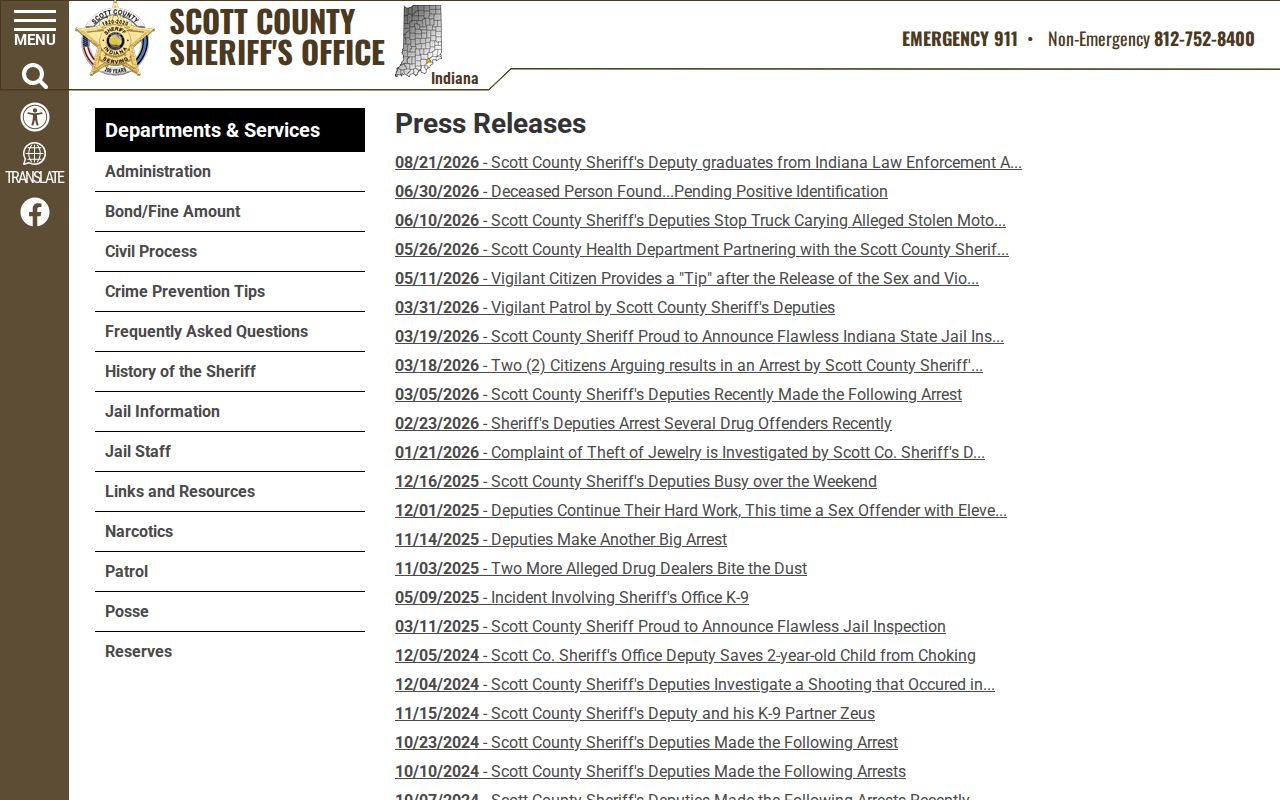
Think of the archive as the agency's official news channel rather than a booking-photo gallery. Items stay selective. They never substitute for the full current roster.
Sheriff Facebook posts plus SMS and email alerts can flag new releases. Social feeds reorder, remove, or highlight items at will. The alert service also covers new site content far beyond arrests. For custody questions, use the jail roster. For judicial outcomes, use Indiana MyCase.
Scott County Herald Arrest Reports
The Scott County Herald archive reveals a distinctive local habit. Issue PDFs from May 12 and June 9, 2021 each carried a weekly "Scott County Sheriff's Department Arrest Reports" section. That is solid proof of a historical newspaper feature covering sheriff arrest information in both Scottsburg and Austin.
It is not proof of a live blotter. The publication page did not show the weekly feature continuing. The extracted text never confirmed a photograph beside each listed arrest either. Cite the pattern in past tense. Then check the current issue instead of assuming an old format survives. The publication page shows the newspaper's public issue route.
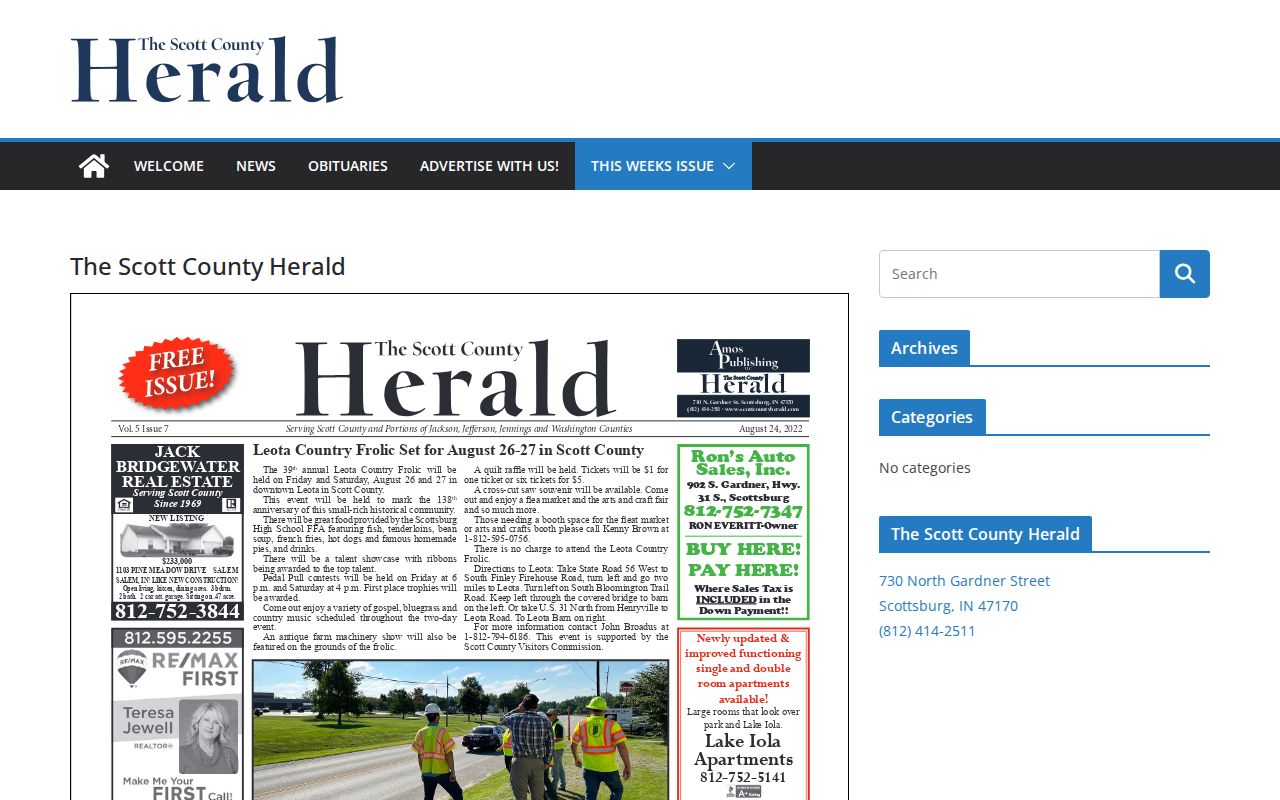
Local news supplies the context. The sheriff roster and court docket remain the sources for present custody and case outcomes.
How Scott County Photos Reach News
A Scott County booking photo is taken at jail admission. Indiana's jail rule requires that intake image. The sheriff displays adult photos in its online roster by choice. Access falls under the state's Access to Public Records Act, subject to applicable exclusions. Public Access Counselor guidance holds that mugshots are not automatically investigatory records an agency can withhold without a consistent, fact-based reason. That same guidance does not force every image to stay online forever.
Newsrooms get these photos a few ways: an agency release, a records request, or material credited to another law-enforcement agency. WDRB's Austin example credited a Scott County Jail image supplied through ISP. WAVE's event-driven reporting shows the same path from sheriff or state-police announcement to regional broadcast. Neither example reflects typical arrest volume.
Publication is an editorial call. The photo identifies the person tied to the case at that stage. Later court developments may never update the story.
Scott County Booking Feed Limits
Scott County has no standalone 24-hour arrest feed. There is no 72-hour list or weekly booking archive either. What exists in practice is the current jail roster, sorted by booking date, plus a latest-booking tile on the sheriff homepage. The only timed official view covers a different thing entirely: people released within the past 48 hours. That window tracks releases, not every arrest made in those two days.
The difference matters. Someone booked months ago but released today can show up in the release view. A person booked today who is still held belongs on the current roster. And someone released more than 48 hours ago might appear on neither page. The booking file can still be requested from the sheriff, though. The press archive can't fill the gap, since it picks newsworthy events. The statutory daily incident log is not an online mugshot feed either. The Scott County roster and booking guide walks through the current, released, and older-record routes in full.
Trace Scott County Arrest Stories
An arrest story can start anywhere. Maybe an agency statement. Maybe a journalist's account, or a copied booking card. What matters is the official record path, which keeps each layer distinct. Publication stays separate from custody. Custody stays separate from the final case result.
- Record the person's full name, the reported arrest date, the agency named in the story, and any booking or case number.
- Search the Scott County current roster for present county custody. Use the separate 48-hour release view only for a recent release.
- If the online window has passed, request the jail booking record and identification photograph from the Scott County Sheriff's Office.
- Search Indiana MyCase using the name and Scott County context. Compare dates and case details rather than relying on a name alone.
- Follow the docket through filed counts, hearings, orders, dismissal, plea, trial, judgment, and sentence, subject to lawful access restrictions.
One arrest can leave paper in three different places. Scottsburg Police or Austin Police may write the incident report. The Scott County Security Center creates the jail booking record and the photo. MyCase then tracks the judicial events that follow. No single source can stand in for all three.
Scott County Charges Can Change
An arrest log and a court docket tell two different stories. The log freezes a case at the moment of booking. Indiana's MyCase system follows it afterward. State data files even flag the gap: the offense listed on an arrest record can differ from amended or final counts, and the paperwork sometimes trails behind. So don't be surprised when a headline, a booking charge, and a docket entry disagree.
Where a case actually goes is decided later. Prosecutors pick the charges they will file. Courts adjust bond, drop counts, accept pleas, and hand down sentences. Indiana law also lets a person ask to seal certain records from public view. Yet the first news story and the copied booking card live on, unchanged, long after any of that. The image caption is not the answer. The docket is.
Unofficial Scott County Mugshot Sites
Five dedicated Scott County sections exist: Busted Newspaper, Recently Booked, Mugshots.com, Arrests.org, and Mugshots.zone. Busted Newspaper offers a deeply paginated county stream plus an Austin tag, though that tag is no reliable filter for where someone lives. Recently Booked carries the clearest dated freshness signal, presented as a rolling past-30-day view. Mugshots.com works more like a historical database than a last-day roster. Arrests.org shows recent indexed cards but follows no dependable publication schedule, and Mugshots.zone looks chronological and active, though nothing ties it to an official source.
All of these services can copy the same sheriff record. Five matching cards are not five independent confirmations. A third-party page may keep an entry after the person leaves the official roster, repeat a typo, or miss a later dismissal. Treat them as secondary landscape resources. Confirm custody with the Scott County Sheriff's Office and outcome with MyCase. No commercial removal service is endorsed or linked here.
Scott County City News Coverage
Scott County has just two incorporated cities. Scottsburg Police and Austin Police both appear as arresting-agency values in county booking records, but neither city runs a verified municipal arrest log or booking-photo feed. A quiet city social page proves nothing about whether arrests occurred.
Local and regional outlets cover both places selectively. The Scott County Herald historically folded both into its sheriff arrest reports, while WAVE and WDRB have covered Austin cases. Anyone narrowing a story by place should not confuse the arresting agency with the person's residence, or with proof that an event happened inside city limits. The county roster, the city agency report, and the court cause number each answer a different part of that question.